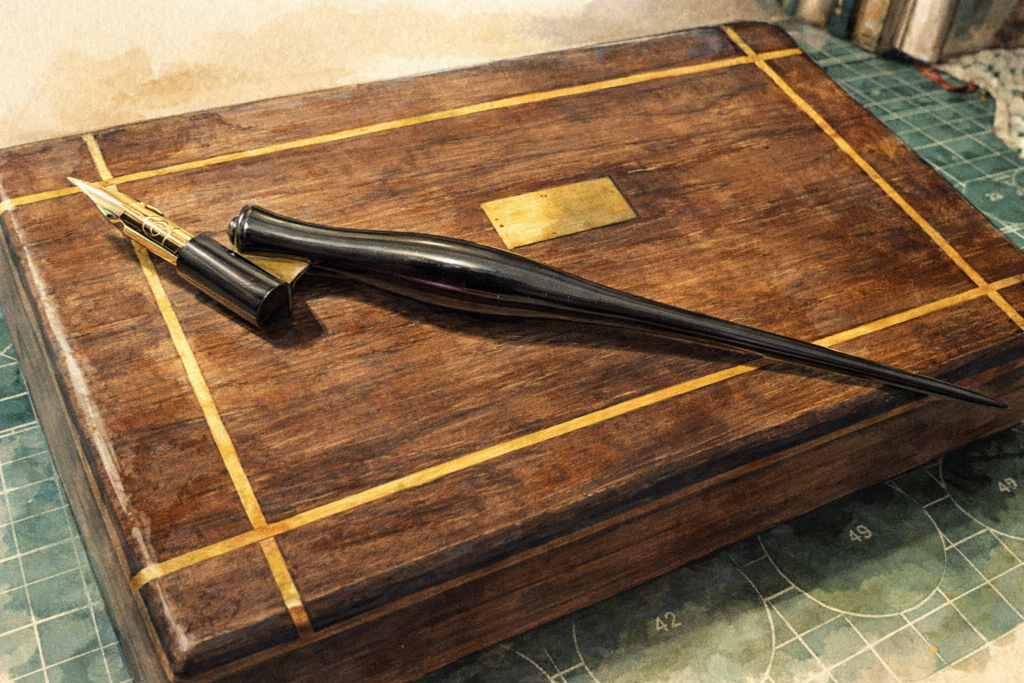
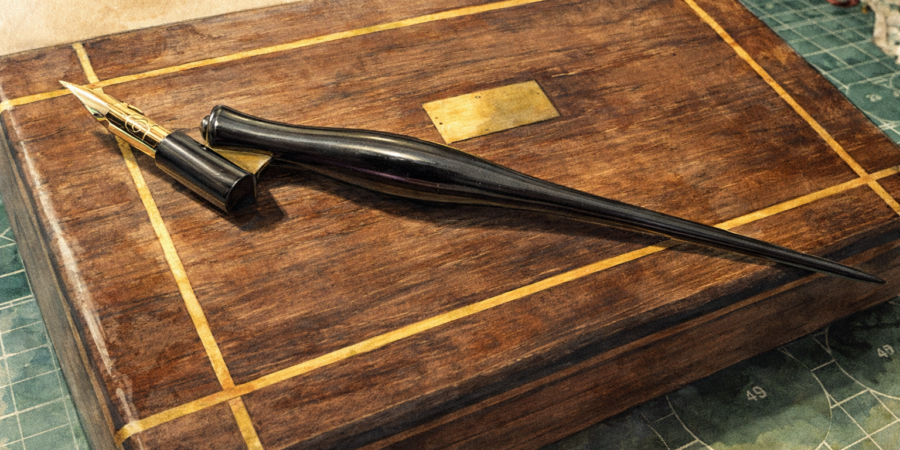
To someone outside of the profession, the oblique pen can look unusual. The nib sits off to the side, held in place by a small metal flange. It seems eccentric. In truth, it is simply intelligent design.
Reason One: To see what is coming out of the nib
Calligraphers use an oblique pen because it improves visibility. When writing scripts such as Copperplate, the thick and thin strokes depend on precise pressure. With a straight pen holder, the hand can block the view of the nib. The oblique holder shifts the nib outward. This small adjustment allows the calligrapher to clearly see the exact point where ink transfers from nib to paper. Seeing that moment improves control.
Reason Two: Weighting of the nib
The angled position also supports correct alignment. Pointed nibs create contrast by spreading under pressure. If the nib meets the page at the wrong angle, one tine can catch or dig into the paper. The oblique holder keeps both tines balanced, so the ink flows smoothly and the strokes remain clean.
Reason Three: Positioning of the nib
There is also a practical benefit. Traditional scripts are written on a consistent slant, often around fifty-five degrees. Without an oblique holder, the writer must twist the wrist to achieve that angle. Over time, this can create strain. The oblique pen allows the hand to remain in a more natural position while the nib maintains the correct slant.
The design is not decorative. It is the result of refinement. Nineteenth-century penmen developed tools that increased efficiency and consistency. The oblique holder endured because it solved real problems.
What appears unusual at first glance is simply a tool shaped by experience. The oblique pen allows the calligrapher to see clearly, control pressure precisely, and write with confidence. It may look different, but its purpose is straightforward: to help ink meet paper beautifully and with intention.